


3–4 Week Old Puppy Development: The Transition from Newborn to Puppy
- Amanda Freeman
- Mar 3
- 4 min read

By Weeks 3 and 4, puppies enter one of the most important developmental windows of their early lives. This stage marks the shift from passive newborns to active, aware, and increasingly interactive little dogs.
At Kiki Leigh Frenchies, this is where our role becomes especially hands-on and purposeful. This isn’t a “set them up and let them figure it out” phase. Every interaction, every exposure, and every adjustment to their environment is done with care. We are actively shaping:
Confidence
Social behavior
Emotional stability
Because what happens during these weeks doesn’t just affect them now 🐾 it directly impacts the kind of dogs they become in their future homes.
Neurological & Sensory Development
As their senses begin to develop, we step in to make sure the puppies are exposed to a variety of sights, sounds, and everyday experiences they will encounter in their daily lives. Puppies are gently introduced to:
Everyday household sounds (voices, movement, normal activity)
Regular handling from multiple people
Paw handling, nail clipping and ear touches
We incorporate periods of acoustic music and calming nature sounds to create a relaxed, safe environment where puppies can sleep and play comfortably.
.
Weaning: The Transition to Solid Food
Weaning typically begins between 3 and 4 weeks, depending on the litter. At this stage, puppies are introduced to a soft, gruel-like food often called “mush,” created by blending their regular high-quality puppy food with puppy milk replacer. It’s similar in concept to baby formula for human infants but designed specifically for puppies. Using an immersion blender, the mixture is smoothed into a consistency that’s easy for them to lap and digest.
Steps to learning to eat solid food:
Puppies are placed around a shallow bowl with a raised center (a weaning dish)
A small amount is placed on their lips to encourage licking
We touch the puppies mouth gently to the liquidy mess
Stragglers or slow eaters are repositioned until they “get it”
Clean up the puppies with a damp washcloth
Let mama in to enjoy the remaining feast and clean her litter
Puppies are offered food every four hours during the day, with a break overnight. As the days go on, the texture is adjusted gradually, becoming slightly thicker each day until they transition to soft food around 6 weeks of age.
At the same time, their mother naturally begins to create distance, spending more time away from the puppies as she returns to her normal routine 🐾 resting on her own, playing, or even heading off with us for parts of the day. As she does this, nursing becomes less frequent, and the puppies begin to rely more on their food. This is a normal and important part of development, as they gradually shift from depending on mom to confidently eating on their own.
Personality Development
This is where things get fun and exciting at Kiki Leigh Frenchies! Watching the puppy sweetness emerge is comparable to getting to eat all the ice cream you want and never gaining weight. Little yips, barks and roly-poly tumbles are part of everyday life and watching it is absolutely magical.
At this stage, we are actively observing:
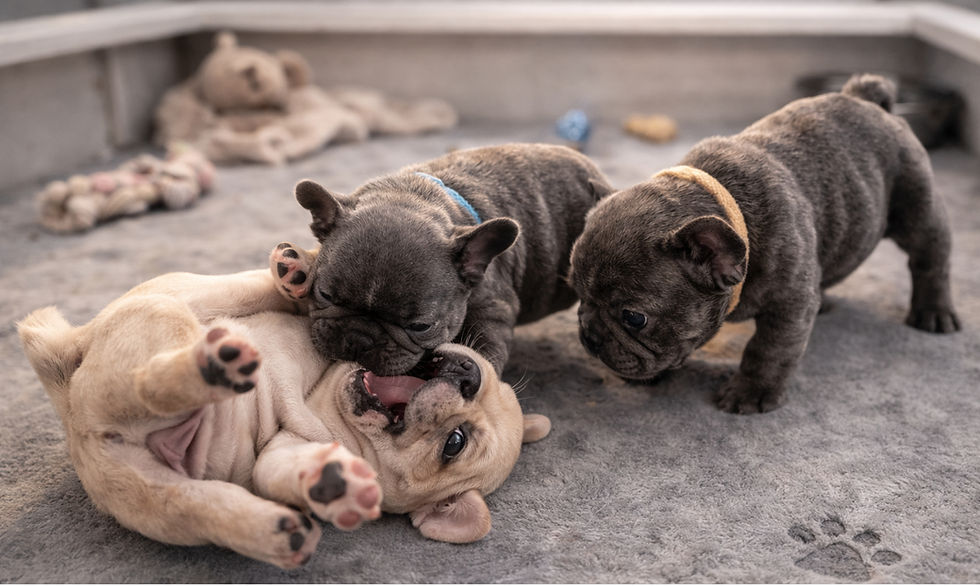
Confidence vs. Shyness
Teething behaviors and chewing
Social interactions within the litter
We’re not just enjoying their personalities 🐾 we’re evaluating and learning about them, which helps us later when matching them with their forever homes.
Early Learning & Human Interaction
By this stage, puppies are becoming much more aware of the people and activity around them, and this is where consistent, positive human interaction really starts to matter.
At Kiki Leigh Frenchies, puppies are handled every day in a calm and reassuring way, allowing them to become comfortable with touch, movement, and human presence. They are raised as part of a normal, active environment, so they are naturally exposed to everyday sights and sounds rather than being kept in isolation.
We also begin by introducing age-appropriate toys, including chew toys, toys that make noise, and simple enrichment items that encourage curiosity and early problem-solving. These small experiences help puppies engage with their environment in a natural way while building confidence.
All of this helps shape puppies that are comfortable with people, adaptable to new environments, and emotionally balanced, making the transition into their new homes feel natural and easy.
Ongoing Monitoring (We Don’t Take Our Eyes Off Them Yet)

At this point, they may look like they’ve got it all figured out, but this is still a stage where we’re paying close attention to the little things, because those are the ones that matter most.
At Kiki Leigh Frenchies, we continue to closely monitor:
· Weight gain and overall growth
· Feeding participation
· Mobility and development
· Social engagement within the litter
This is the age we start to prepare to move the puppies from their sheltered whelping box area and into the main living area of our home. This makes it easy to always keep an eye (and an ear) on them. At Kiki Leigh Frenchies, each puppy is raised with care, consistency, and close attention to their individual needs. When they leave our family and join yours, they’re not just ready for a home, they’re ready to become a beloved member of your family.


Comments